Speaker: Dr Ernst M. Conradie, Senior Professor of Systematic Theology and Ethics, Department of Religion and Theology, University of the Western Cape,
Response by Dr HyeRan Kim-Cragg, Principal of Emmanul College and Timothy Eaton Memorial Church Professor of Preaching
Date and Time: Thursday, November 12, 7:00 8:30 PM (with reception to follow)
Calling all RSM students and faculty! Join us as we discern together the way ahead in the use of AI in theological education.
Step 1: All students are invited to share your views by filling in this survey by Oct 15: https://bit.ly/RSM-AI-survey
Step 2: Students and faculty are invited to join a synodal discussion on Oct 22 from 4 – 6pm (online option available). The fruits of this shared discernment will help to inform our practices in using AI at RSM. Save the date – further details to come!
At Regis St. Michael’s Faculty of Theology (RSM), responding to the Calls to Action set out by the Truth and Reconciliation Commission of Canada (TRC) remains a guiding priority in how the school prepares people to serve the Church, its Indigenous communities, and to understand the damage it has caused many of its members. RSM’s new strategic plan positions truth and reconciliation as a top priority in the Faculty, with Indigenous spirituality along with the legacy of residential schools and the Church’s role in that system gradually being woven into RSM’s curriculum.
“Regis St. Michael’s has been very intentional about its commitment to truth and reconciliation, particularly the call for churches, religious orders, and academic institutions to address how the Church was complicit in the residential school system. We’re educating our students but also finding new ways we can contribute to reconciliation and supporting Indigenous students,” says Prof. Jaroslav Skira, Dean of RSM.
Faculty discussions have guided curriculum development, focusing on how to meaningfully integrate Indigenous voices, creatively present the material, and build sustained relationships with Indigenous communities. RSM has also committed to this work through public lectures, and financial support for students, along with a grant from Lilly Endowment’s Pathways for Tomorrow that will significantly advance this priority.
This work was done to respond directly to the TRC’s Call to Action No. 60, which calls on Church leaders and theological schools to work with Indigenous spiritual leaders and residential school survivors to develop curriculum that respects Indigenous spirituality and addresses the legacy of residential schools.
“We call upon leaders of the church parties to the Settlement Agreement and all other faiths, in collaboration with Indigenous spiritual leaders, Survivors, schools of theology, seminaries, and other religious training centres, to develop and teach curriculum for all student clergy, and all clergy and staff who work in Aboriginal communities, on the need to respect Indigenous spirituality in its own right, the history and legacy of residential schools and the roles of the church parties in that system, the history and legacy of religious conflict in Aboriginal families and communities, and the responsibility that churches have to mitigate such conflicts and prevent spiritual violence.”
– Truth and Reconciliation Commission no. 60
RSM continues to deepen its engagement with truth and reconciliation, with 20 to 30 courses directly addressing TRC-related themes. Among these are many of the foundational courses for RSM’s degree programs, including the Introduction to the New Testament, Catholic Spirituality and Education, and Education and Liberation.
A course offered by Prof. Cynthia Cameron, Associate Professor of Religious Education and the Patrick and Barbara Keenan Chair in Religious Education at the Faculty of Theology, titled Catholic Residential Schools addresses the residential school system and the Church’s role in it directly.
“This course looks primarily at the theological question of Residential Schools, rather than the historical question. So, we look at why Catholic religious orders became involved in the running of Residential Schools, at the theological assumptions that led these religious orders to support and perpetuate the abuse and cultural genocide. And we look to contemporary theologies that can undergird a more just relationship with Indigenous people, in schools, in ministry, and in wider Canadian society,” explains Cameron.
Learning in Indigenous-Led Spaces
RSM’s growing roster of experiential learning courses also incorporates truth and reconciliation, giving students the opportunity to encounter Indigenous spirituality firsthand in Indigenous-led spaces.
Retreat in the Streets, an experiential learning course, which began in 2025, seeks to find God in the people and places that one encounters in Toronto. Part of the course includes a site visit to UofT’s First Nations House. Another summer experiential course, Interfaith in the City takes students to visit different houses of worship all over the city, includes a visit to an Indigenous community centre to understand and explore Indigenous spiritualities and notions of the sacred.
Students in the Food/Justice Farming and Eco-Theology in the City tour Toronto Metropolitan University’s Indigenous Foodways Program.
This past summer, Food/Justice, Farming and Eco-Theology in the City, taught by Prof. Hilda Koster, Director of the Elliott Allen Institute for Theology and Ecology at RSM, took students on a tour of Toronto Metropolitan University’s Indigenous Foodways Program. The visit combined theological and ethical perspectives with Indigenous knowledge and community initiatives to address a range of social justice issues related to food.
Walking in Service: Building Long-Term Relationships
Efforts to engage Indigenous communities in relationships of learning, reconciliation, and shared wisdom will continue to deepen through the Walking in Service initiative. Funded through the Lilly Endowment’s Pathways for Tomorrow Initiative, it seeks to develop educational resources and programs to support the community-based formation of congregational leadership in Catholic Indigenous communities in Canada.
Offerings will range from professional development workshops, Windows on Theology continuing education courses, to newly developed credit courses. Adjunct faculty and community-recognized Elders with competencies in Indigenous pedagogies, ways of knowing, cultures and history will be hired to teach, mentor students, and support curricular development.
Initiative director, Prof. Trevor Scott, SJ, notes that this project has been developed in support of the formation of Indigenous congregational leaders within the Roman Catholic Church in Canada. It is rooted in the healing journey that has begun to emerge in the wake of Pope Francis’s 2022 Penitential Pilgrimage, affirming reconciliation as a shared spiritual and social task, including amongst theological faculty and students. This initiative addresses the pressing need for contextualized, trauma-informed theological education that seeks to respect Indigenous self-determination, incorporates land-based and culturally relevant pedagogies, and prepares leaders for their needed presence as catechists, lectors, and acolytes.
Doctoral students participated in a research retreat held at the Anishinaabe Spiritual Centre where they collaborated on a research paper.
A pilot program of this initiative took doctoral students on a research retreat held at the Anishinaabe Spiritual Centre in Espanola, a training centre for Anishinaabe Catholic leaders, originally established by the Jesuits and now run in partnership between local Indigenous members and the Diocese of Sault Ste. Marie.
Students from the retreat will be speaking on a panel marking National Day for Truth and Reconciliation (NDTR) on September 30 at St. Joseph Chapel at Regis College.
Marking National Day for Truth and Reconciliation
The University of St. Michael’s will also take part in a number of events in observance of NDTR. St. Michael’s Campus Ministry team will take a group of students to the Indigenous Legacy Gathering Sunrise Ceremony at Nathan Phillips Square. See the Gathering’s full schedule. St. Michael’s College Student Union will host a Truth and Reconciliation Gathering with speakers and community conversation in the COOP.
Islam, Christianity and Modernity (SMT3800H/6800H)
This course will examine how modern Muslim and Christian thinkers have attempted to grapple with how religious belonging and faith can exist in increasingly pluralist and secular societies. Course lectures will explore themes such as religious cultural imaginaries, human dignity, peace-building, spirituality and advancements in modern science and technology.
Contemporary Topics in Islamic Theology (SMT3810H/6810H)
Working from the perspective of Islamic theology, this course will explore questions such as religious belief and atheism; theodicy; political theology; war and peacebuilding; the ecological crisis and artificial intelligence. These questions will be situated in historical discussions of Islamic theology in dialogue with contemporary Islamic thought. It will explore a variety of writings by prominent contemporary Muslim thinkers who grapple with such theological questions and their implications for how human beings understand themselves and their place in the universe.
In-course awards:
Stay tuned for more details about merit-based essay contest awards for students registered in these courses.
The Regis St. Michael’s Faculty of Theology offers our warmest congratulations to Sr. Carla Thomas, OP, on being named the 2025 recipient of the Governor General’s Award. The award is presented annually to the doctoral student with the highest academic standing.
Sr. Carla was to receive her medal at the inaugural convocation for the Regis St. Michael’s Faculty of Theology, held Saturday, Nov. 8, at 2 p.m. in St. Basil’s Church.
“It is incredible,” says the Guyanese-born Sister, who belongs to the Congregation of Dominican Sisters of St. Catherine of Siena of Étrépagny in Trinidad and Tobago. “I feel immensely grateful.”
Long interested in adult faith formation, Sr. Carla enrolled in the St. Michael’s Faculty of Theology in 2017 to work on a Master of Theological Studies (MTS) degree to further her knowledge, a move she notes was fostered, encouraged and organized by her congregation.
“All credit goes to my congregation,” she says, adding that the general prioress at that time, Sr. Therese Antoine, and other sisters found St. Michael’s appealing for a variety of reasons, ranging from a Dominican presence at St. Michael’s, and in the city, to the Catholic ethos underpinning the faculty.
Once enrolled, Sr. Carla was encouraged by the supportive, dynamic community she found. She also appreciated the ecumenical approach she discovered on campus, including the presence of the Metropolitan Andrey Sheptytsky Institute of Eastern Christian Studies (MASI), as well as the opportunities to take courses at all the other member colleges of the Toronto School of Theology along with the courses offered at St. Michael’s.
As her MTS studies were wrapping up, Sr. Carla discerned a desire to further deepen her knowledge and was encouraged to enrol in a doctoral program. Inspired by her own ministry contexts and the need she felt for her research to connect with the works of her religious congregation, she pursued a thesis examining Pope Francis’s contributions to family life in contexts marked by colonial histories. Her dissertation set out to propose recommendations of themes and orientations for a regional pastoral strategy aimed at accompanying the various kinds of families present in the Anglophone Caribbean. She points out that while family life is a pressing concern for the global church, the legacy of colonialism has long complicated the Church’s ministry in the region on this issue. This dissertation takes its place in the trajectory of studies by other scholars from the Caribbean who have wrestled with this subject. However, in scope and ecumenical attentiveness, it seems to be the first of its kind from a Roman Catholic perspective.
Sr. Carla undertook this research because she is mindful of the people she has encountered in her ministry who give endlessly of their time and talents to the Church but also face many challenges with church norms and teachings about family.
“I wanted my dissertation to reflect how theology impacts people,” she says.
Now finished her studies, she hopes to continue the work she has been doing with the Regional Seminary of St. John Vianney and the Uganda Martyrs in Trinidad and Tobago, work she had been engaged in for the final two years of her studies.
She was also selected recently to participate in the 2025-2026 cohort of an international panel of women religious theologians, an initiative of the International Union of Superiors General (UISG), where she will use her theological training to examine challenges and opportunities that will loom large for consecrated life and the Church in the future.
As she reflects on her time in Toronto, Sr. Carla calls on a phrase coined by Dominican theologian Timothy Radcliffe to describe her experience.
“There is an ‘ecology of flourishing’” she says of life at Regis St. Michael’s. At RSM she found an eco-system of relationships, community and concern for the wider creation which enriched her studies.
“Sr. Carla has been a wonderful addition to life and learning of Regis St. Michael’s. An insightful and inspiring person, we are grateful she selected RSM for her doctoral work because our community has been enriched by her presence. We are confident she will go on to do important work in service to the Church, the academy and her community,” says RSM Dean Jaroslav Skira.
Sr. Carla expresses great thanks to her supervisor, Prof Michael Attridge, committee members Prof. Darren Dias, OP, and Sr. Susan Wood, SCL, her external examiners, various faculty and staff; her friends and colleagues in the doctoral program at RSM; her family, her community, the Dominican friars and her parish in Toronto, Our Lady of Good Counsel Caribbean Canadian Catholic Church.
And, of course, “I feel immense gratitude to God, and to God’s mercy.”
Her dissertation, she says, represents the fruits of contemplation, discovered both in prayer and in hard work in the library.
“I have a sense of gratitude and fulfillment,” she says, adding that she is keen to share her work with Caribbean theologians as well as people here in Toronto.
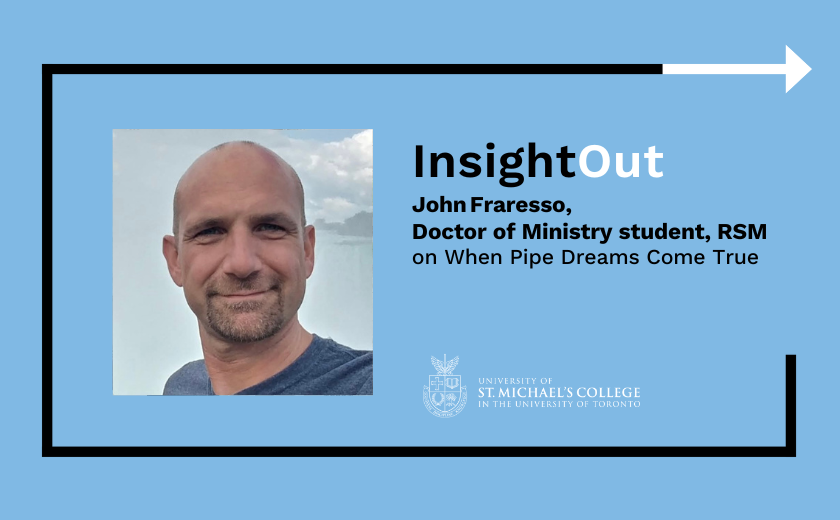
John Fraresso is currently in his second year of the Doctor of Ministry program at the Regis St. Michael’s Faculty of Theology (RSM) and is the Spiritual & Community Life Coordinator at L’Arche Hamilton.
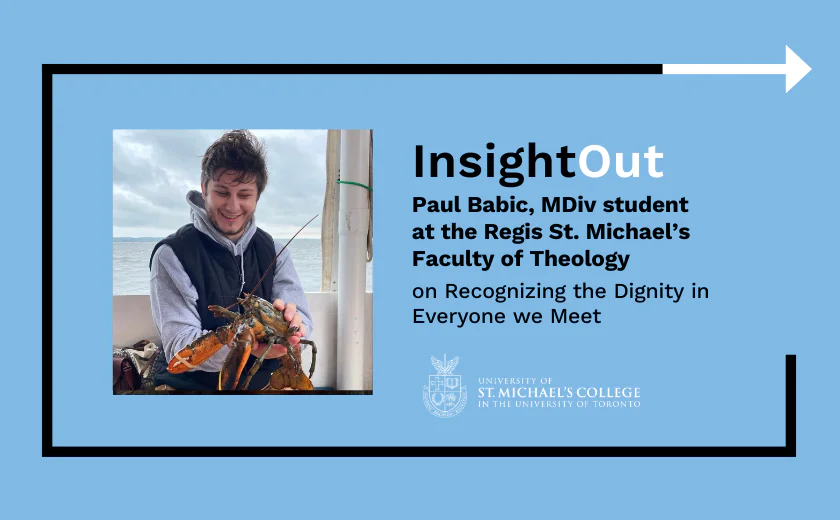
Regis St. Michael’s student Paul Babic reflects on a papal invitation to respect the dignity of all.